Mandatory Information on Packaging in 2026: Physical vs. Digital
Mandatory Information on Packaging in 2026: Physical vs. Digital
Topics: Regulatory Compliance · Packaging · Digital Product Passport
Reading time: ~9 min
This guide covers: Food and Beverages · Electronics · Textiles and Apparel · Cosmetics · Pharmaceuticals · Batteries · Chemicals and Detergents · Toys
Tags: EU Labelling, Digital Product Passport, QR Code Compliance, ESPR, FIC, WEEE, Battery Regulation
One of the most practically relevant questions in EU product compliance right now is deceptively simple: what information legally has to appear on the physical packaging, and what can (or must) move to a digital channel?
As QR codes, Digital Product Passports (DPP), and e-labelling initiatives mature across EU legislation, the landscape is shifting faster than many compliance teams realise. The short answer is that it depends entirely on the product category and the specific regulation governing it.
Note: Digital Product Passport (DPP). The EU's Ecodesign for Sustainable Products Regulation (ESPR, EU 2024/1781), in force since 18 July 2024, is progressively rolling out Digital Product Passports across categories, starting with textiles and footwear. The DPP registry must be operational by 19 July 2026. Further delegated acts per sector are still pending.
There is no single EU-wide rule that permits or prohibits digital labelling as such. Instead, each sectoral framework, e.g. as further described in this article food, electronics, cosmetics, pharma, batteries, chemicals, textiles toys, contains its own provisions about what must appear physically on the label, what may additionally or exclusively be provided digitally, and what remains legally unresolved.
This guide works through eight major categories systematically. For each mandatory information element you will find the regulatory status and, where the legal situation is still open, a clear flag explaining what is not yet settled and why it matters for compliance planning today.
Note: This guide covers EU law only. US requirements (FDA, FTC, CPSC, state-level rules) differ significantly. Always verify against current EUR-Lex sources and consult qualified legal counsel for your specific situation.
Understanding the Three Statuses
Before diving into the categories, it helps to understand the three possible compliance statuses for any piece of mandatory information:
- "Must be physical" means the information must appear on the physical label. Providing it digitally alone, even via a prominent QR code, does not satisfy the legal requirement, even if digital is additionally permitted as a supplement.
- "Digital only OK" means the information can legally be provided exclusively via digital means (QR code, URL, app). No physical label presence is required by law.
- "Both required" means the physical label is legally mandatory AND digital provision is additionally required or expected: the physical and digital layers are complementary, not interchangeable.
Where the legal situation is not yet fully settled, e.g. because a revision, delegated act, or pilot programme is underway, items are flagged as "Regulatory open". These are not minor footnotes: several open items affect core labelling obligations for major product categories.
1. Food & Beverages
The Food Information to Consumers Regulation (EU FIC 1169/2011) is the foundational legal text for food labelling in the EU. It is strict: nearly all core label elements are physical-only. A revision proposed in 2023 would allow nutritional information to be supplemented digitally, but as of early 2026, this has not yet been adopted into binding law.
The core rule is straightforward: allergen information, the full ingredients list, best-before and use-by dates, and net weight must always appear on the physical pack. These are not negotiable under current law, regardless of how visible or accessible a QR code may be.
The only area where digital is already accepted relates to supplementary storage and preparation details that go beyond what is safety-critical. Recycling and packaging disposal information is currently voluntary, but the Packaging and Packaging Waste Regulation (PPWR) proposal will make on-pack recycling labels mandatory around 2028, with digital access also required.
For food companies operating in the EU, the practical implication is clear: invest in robust physical label compliance now, and build the digital infrastructure, particularly QR linking, in anticipation of the PPWR and FIC revision requirements that are coming.

2. Electronics & Electrical Appliances
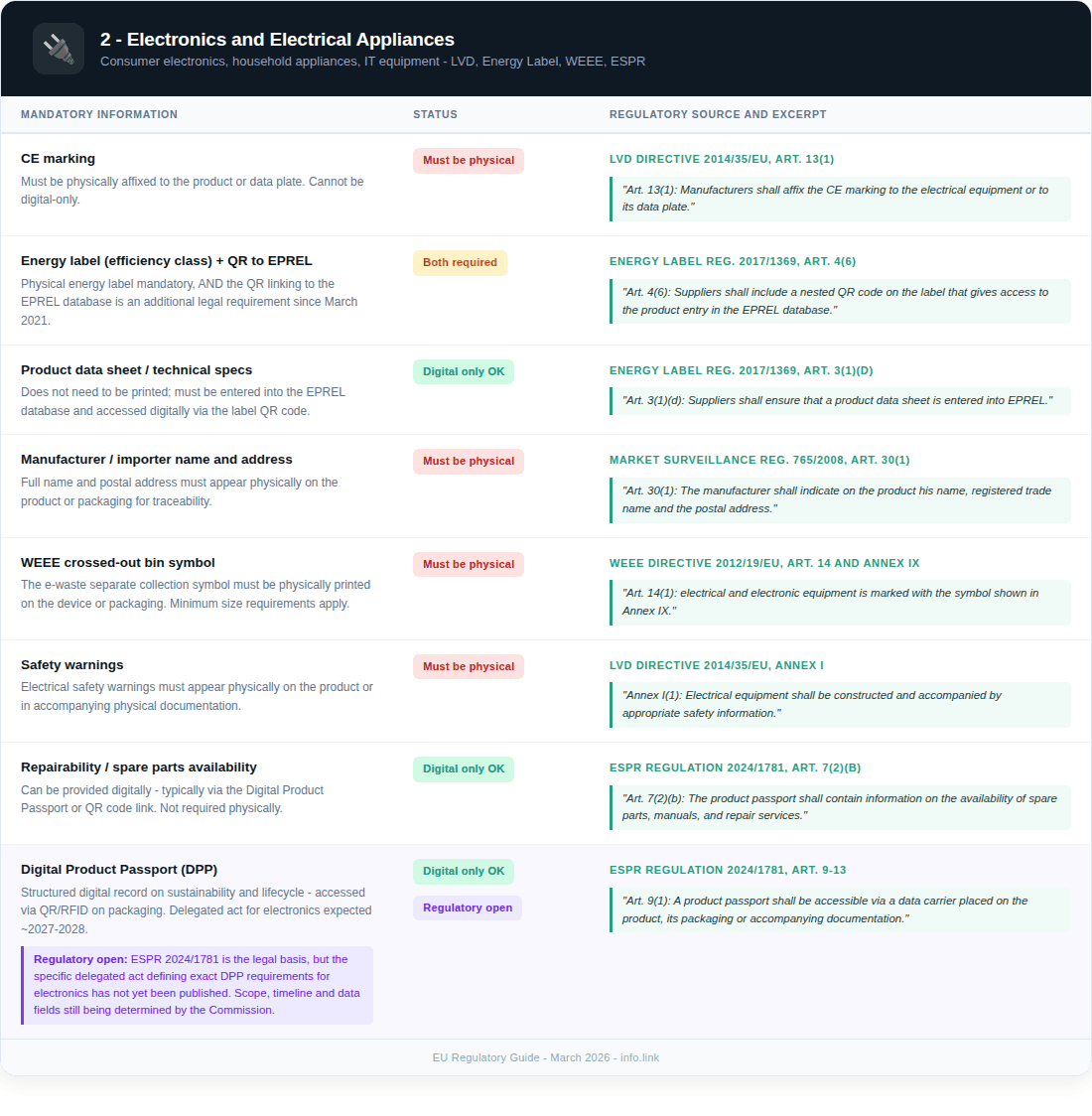
Electronics labelling involves multiple overlapping frameworks: the Low Voltage Directive (LVD 2014/35/EU), the Energy Label Regulation 2017/1369, the WEEE Directive 2012/19/EU, and the new ESPR 2024/1781.
One requirement that catches many businesses off guard: the QR code linking to the EPREL database has been legally mandatory since March 2021; it is not an optional enhancement. The physical energy label with its efficiency class is mandatory, and the QR linking to the product's EPREL database entry is an additional, separately enforceable legal requirement. Many manufacturers are still not in full compliance with this.
The product data sheet itself, however, does not need to be printed. It must be entered into the EPREL database and accessed digitally via the label QR code: a good early example of the physical-digital complementarity that will define EU labelling going forward.
CE marking, the WEEE crossed-out bin symbol, manufacturer name and address, and safety warnings all remain firmly in the physical-only category. The Digital Product Passport for electronics is coming, but the specific delegated act is expected around 2027, and its exact data fields and scope are still being determined by the Commission.
3. Textiles & Apparel
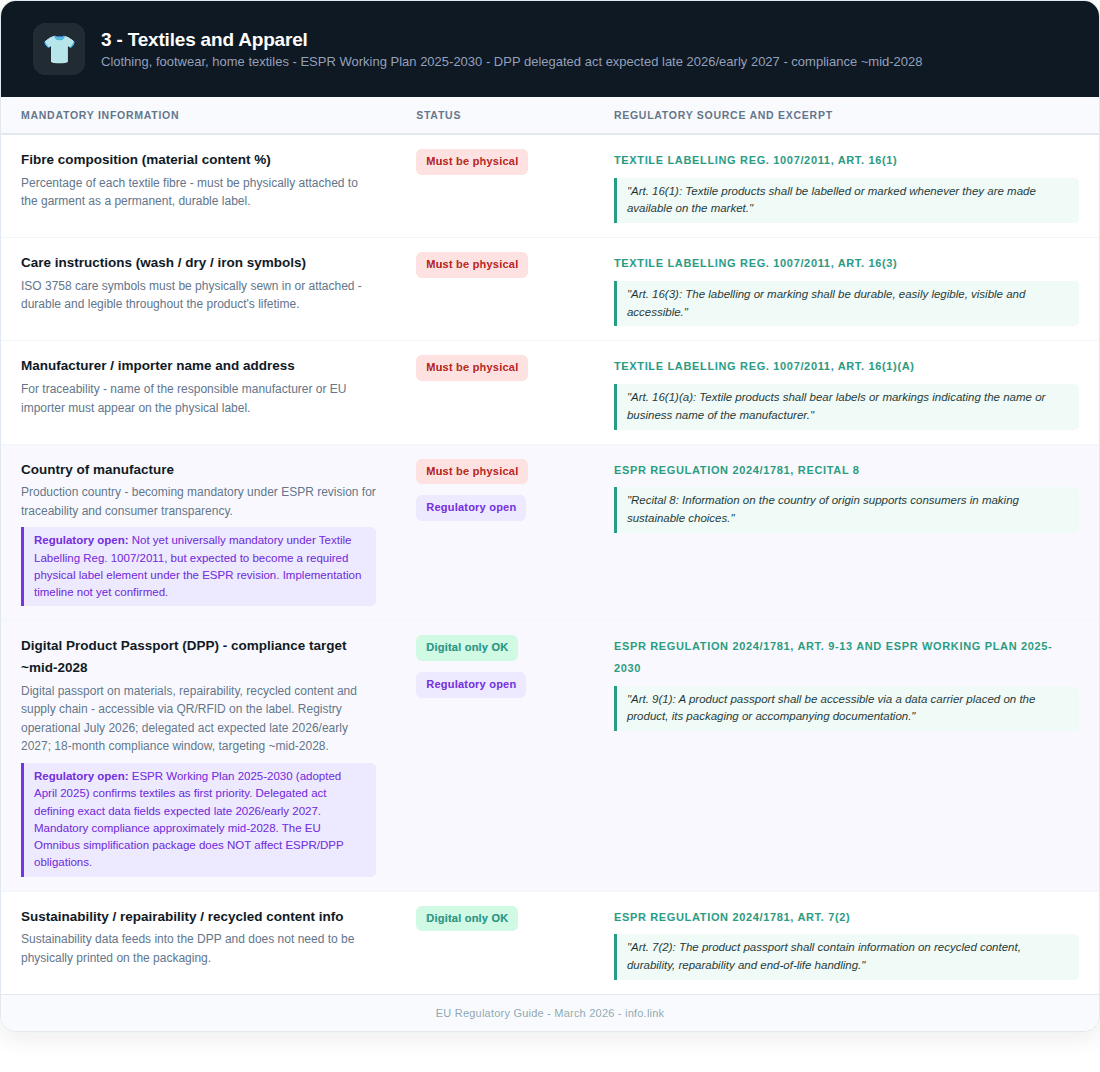
Textiles are the first product category for which a Digital Product Passport is mandatory — with the DPP registry required to be operational by July 2026 under ESPR 2024/1781. This makes the sector the one to watch most closely for compliance teams building future-proof labelling infrastructure.
The classic physical requirements remain: fibre composition percentages and ISO 3758 care symbols must be durably and permanently attached to the garment as physical labels. Manufacturer name and address must also appear physically. These are non-negotiable under Textile Labelling Regulation 1007/2011.
Country of manufacture is becoming increasingly important. While it is not yet universally mandatory under the current Textile Labelling Regulation, it is expected to become a required physical label element under the ESPR revision, in the interest of consumer transparency and supply chain traceability.
All sustainability data, e.g. recycled content, repairability scores, supply chain information and environmental footprint data moves into the Digital Product Passport. This does not need to be physically printed on the packaging. But the QR or RFID data carrier that gives access to the DPP must appear on the physical label, creating the now-familiar pattern: physical label as the portal, digital layer as the depth.
The specific delegated act for textiles defining exact DPP data fields, formats, and verification requirements is still in preparation. Brands should be building the infrastructure now, in anticipation of the requirements becoming concrete.
4. Cosmetics & Personal Care
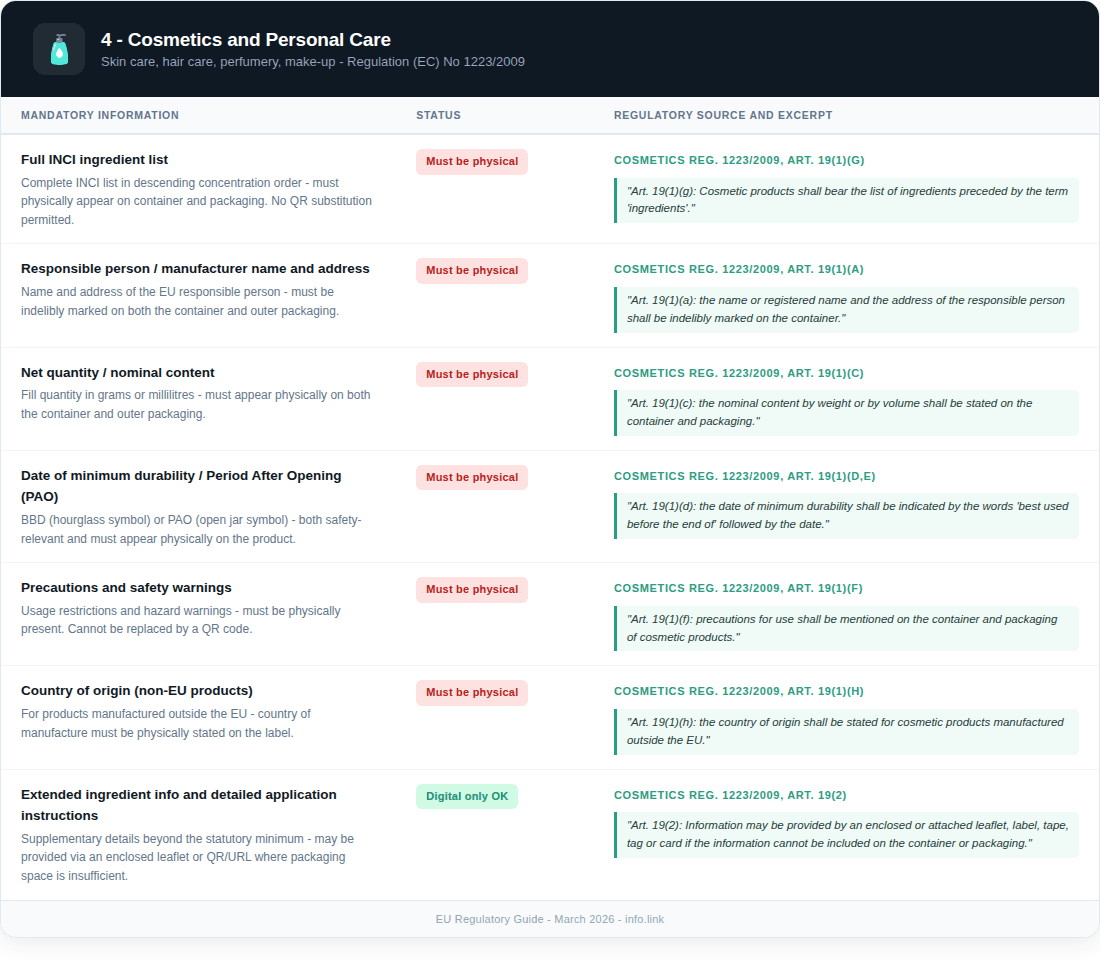
The EU Cosmetics Regulation 1223/2009 is one of the strictest labelling frameworks in the EU and one of the least digitally permissive. Almost all mandatory elements must be physically present on both the container and the outer packaging.
The full INCI ingredient list, the name and address of the EU responsible person, net quantity, the date of minimum durability or Period After Opening (PAO), all precautions and safety warnings, and the country of origin for non-EU products: all of these must be physically on the label. There is no provision under current law for any of these to be replaced by a QR code.
The one area where digital is accepted: supplementary ingredient information and detailed application instructions that go beyond the statutory minimum may be provided via an enclosed leaflet or, where packaging space is insufficient, via a digital link. But this is a supplement to physical compliance, not a substitute for it.
For cosmetics brands, this means the label real estate challenge is real and ongoing. The only path to reducing physical label complexity is to maximise use of the "space insufficient" exception; with care, because regulators have historically interpreted this narrowly.
5. Pharmaceuticals & OTC Medicines
Pharmaceuticals operate under the strictest labelling regime of any category in this guide. Directive 2001/83/EC leaves very little room for digital substitution in the core label and pack insert requirements.
All outer packaging elements (product name and INN, strength, dosage form, excipients with recognised effects, expiry date) are physical elements. The Patient Information Leaflet (PIL) must be physically enclosed in every pack.
The one area where both physical and digital are required simultaneously is the unique identifier: a physical 2D Datamatrix barcode is mandatory under Delegated Regulation 2016/161, and it encodes data verified against the EU medicines verification database, making it a physical element that enables a digital check.
The most significant open question in pharma is the EMA's electronic Product Information (ePI) pilot, which ran through 2022–2025 and tested whether a digital PIL could complement or eventually replace the paper version. As of early 2026, no legislative change has been adopted. The outcome of the pilot will inform any future legislative proposal, so this is one to watch closely.
The Summary of Product Characteristics (SmPC), which is the prescriber-facing document for healthcare professionals, is already fully accepted in digital form and does not need to be physically enclosed.

6. Batteries & Accumulators
EU Battery Regulation 2023/1542 is the most structurally interesting regulation in this guide from a digital labelling perspective, because it explicitly and legally mandates both a physical label element and a digital record and defines the relationship between them.
The physical label must include: battery chemistry, capacity (Wh/Ah/nominal voltage), the crossed-out bin separate collection symbol, and hazardous substance chemical symbols (Hg, Cd, Pb) where applicable above threshold. These are all firmly physical-only requirements.
But the Battery Passport (the digital record containing CO₂ footprint, recycled content percentages, state of health data, and supply chain information) is digital-only, accessed via a QR code that is itself a legally mandatory physical label element under Art. 13(6). Both the QR and the Passport it links to are required by law.
The Battery Passport is mandatory for EV batteries from February 2027, with industrial batteries following shortly after. The detailed technical requirements (data format, platform specifications, third-party verification protocols) are still being developed through implementing acts. The legal basis is firmly in place; the operational detail is pending.
This is the most concrete example currently in force of EU law treating physical and digital as a mandatory system, not a choice between alternatives.

7. Chemicals, Cleaning & Detergent Products
Chemicals labelling operates under two overlapping frameworks: the CLP Regulation 1272/2008 for hazard classification and labelling (always physical), and the Detergents Regulation EU 2023/2055 which from October 2025 introduced the first binding mandatory QR code for household cleaning products in the EU.
Under CLP, all GHS hazard pictograms, signal words (Danger/Warning), H-statements, P-statements, and UFI codes must appear physically on the label. These cannot be moved to a QR code under any provision. The UFI code, a 16-character alphanumeric identifier for poison centre reporting, has been mandatory on physical labels since January 2021.
From 31 October 2025, however, detergents sold in the EU must additionally display a QR code on-pack that links to the full ingredient information, including enzymes, fragrances, preservatives, and dosage recommendations. The core ingredient categories still appear on the physical label, but the detailed breakdown is now mandatory in digital form as well.
Safety Data Sheets (SDS/MSDS) for professional and industrial users are already fully accepted in digital form under REACH Regulation 1907/2006: electronic transmission has been valid for years.
The exact scope of what must be covered in the digital QR link for detergents, the format requirements, and accessibility standards are still being specified in implementing measures.

8. Toys & Children's Products
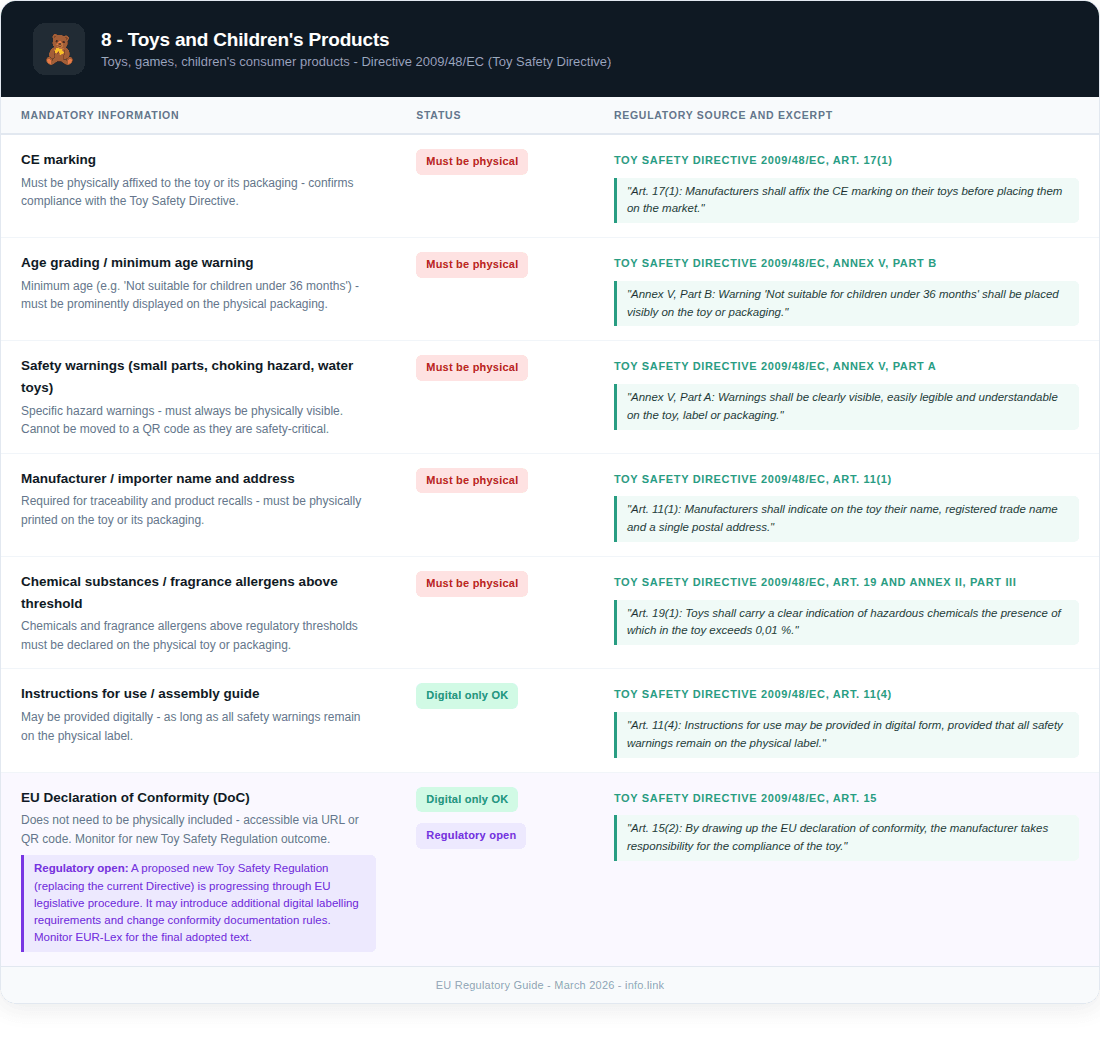
The EU Toy Safety Directive 2009/48/EC applies the most conservative approach to digital labelling of any category covered here and for obvious reasons: the safety risk of a consumer missing a critical warning because it was hidden behind a QR code is simply unacceptable.
CE marking must be physically affixed to the toy or its packaging before market placement. Age grading warnings (e.g. "Not suitable for children under 36 months") must be prominently and physically visible. Choking hazard warnings, water toy warnings, and all other specific safety warnings must appear on the physical label — there is no digital exception for safety-critical information in toys.
Manufacturer and importer name and address must be physically printed for traceability and recall purposes. Chemical substances and fragrance allergens above regulatory thresholds must be declared on the physical label.
Digital channels are accepted for: assembly instructions and detailed instructions for use (provided all safety warnings remain on the physical label), and the EU Declaration of Conformity (DoC), which may be made available via a URL or QR code.
An important open item: a proposed new Toy Safety Regulation is progressing through EU legislative procedure to replace the current Directive. Its final text may introduce additional digital labelling requirements and could change the conformity documentation rules. Compliance teams in the toy sector should monitor EUR-Lex closely.
Key Takeaways
Looking across all eight categories, several patterns emerge clearly.
- Safety-critical information always stays physical. Hazard warnings, allergen information, expiry dates, and CE markings remain on the physical label across every category. This is the non-negotiable floor in every EU regulation covered here, and there is no current legislative movement to change it.
- QR codes are increasingly a legal requirement, not just best practice. For batteries under EU 2023/1542, for detergents from October 2025 under EU 2023/2055, and for energy-labelled appliances since March 2021 under EU 2017/1369, the QR code is a legally mandated label element. Not including it creates a compliance gap, not a design choice.
- The Digital Product Passport is the defining structural shift of the next three years. ESPR 2024/1781 introduces mandatory DPPs starting with textiles in 2026, then rolling out to electronics, batteries and all other sectors. Every compliance team should be tracking the delegated acts for their category — the exact data fields, formats and verification requirements are being defined now.
- Several key items are still regulatory open. The FIC revision on nutritional information, Battery Passport implementing acts, the textiles DPP delegated act, EMA ePI pilot outcomes, and the new Toy Safety Regulation are all still in process. Infrastructure decisions made now may need revision as these items resolve. Build in flexibility.
- Physical and digital must be treated as a connected system. In most categories the question is not "physical or digital?" but "what goes where?" Core identity and safety information stays physical; extended product data moves digital. The physical label is increasingly becoming the portal: carrying the QR, barcode or data carrier that gives access to the richer digital layer.
Digital Product Labels with info.link
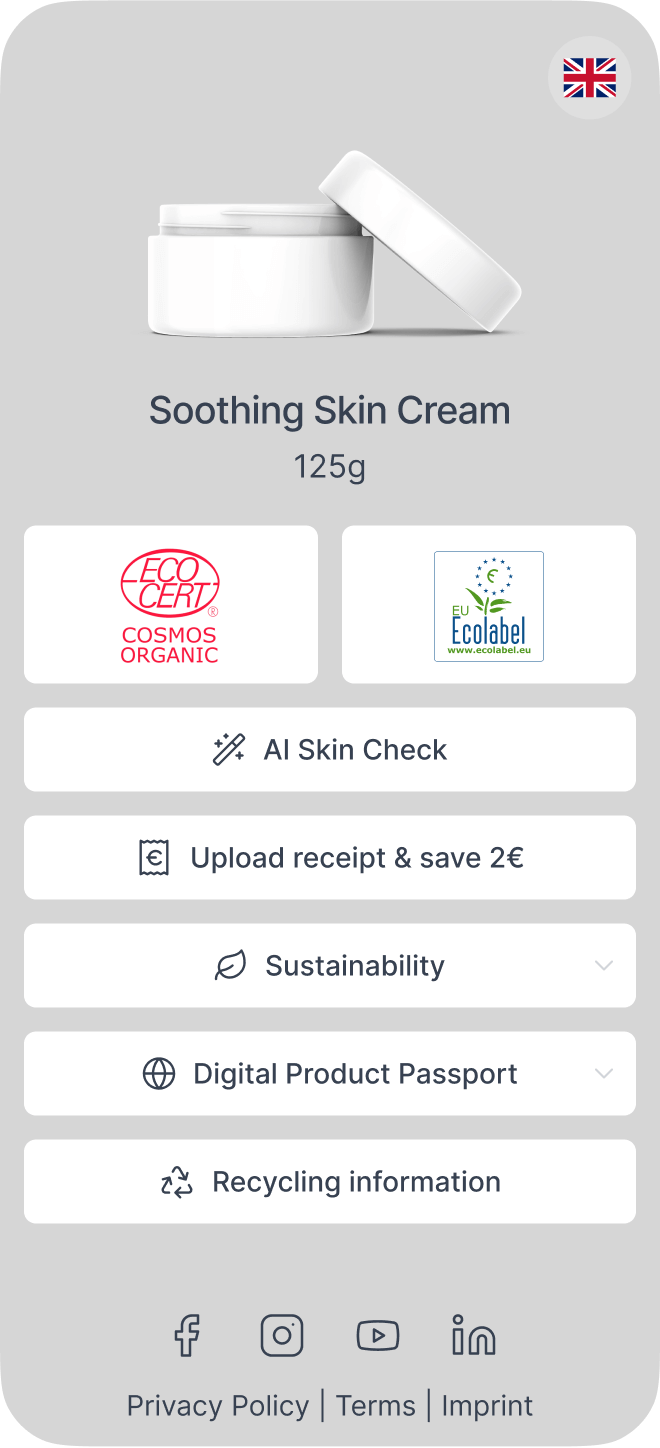
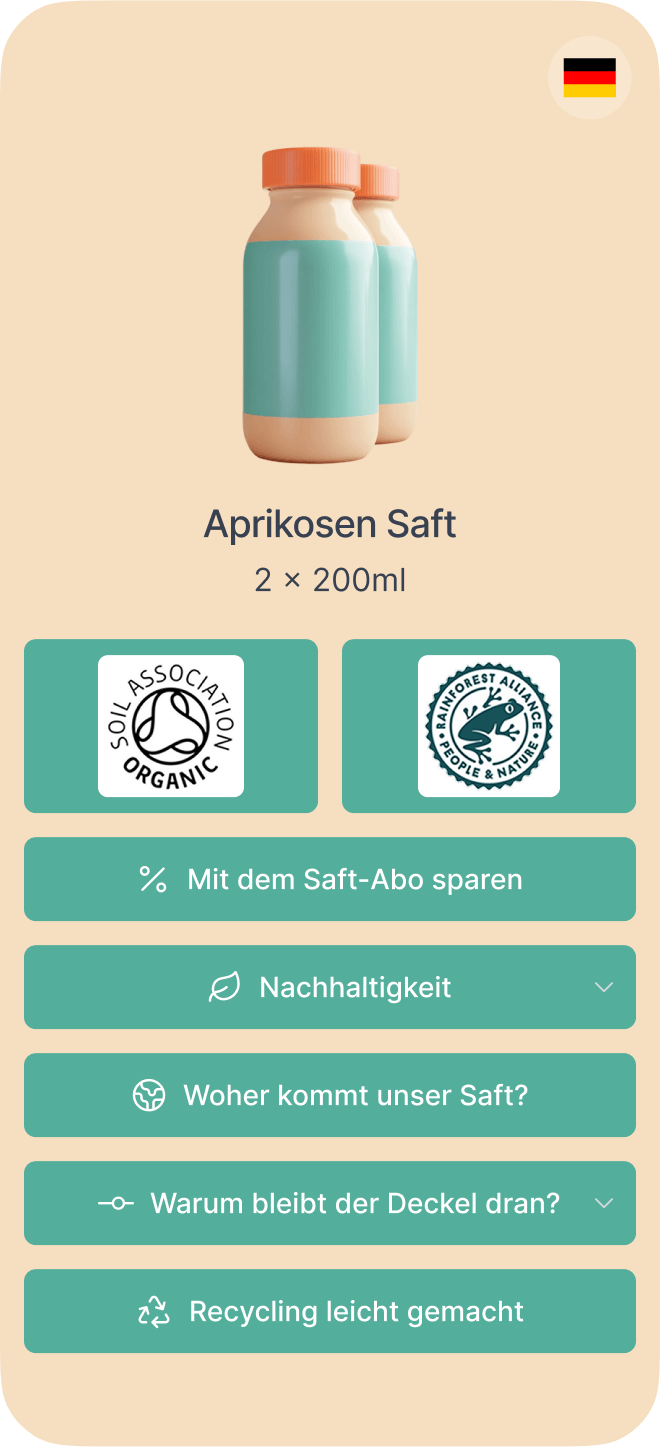
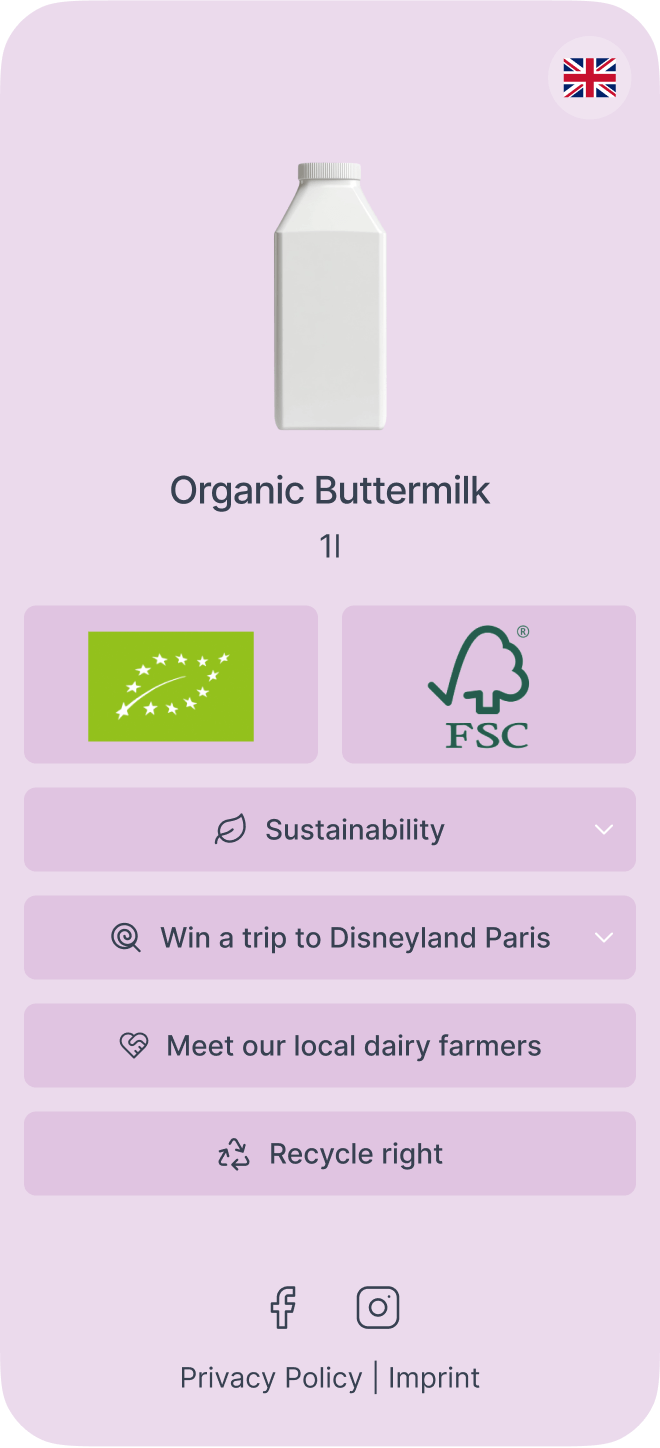
For brands navigating the transition from purely physical labelling to the physical-digital hybrid system that EU regulation is building toward, info.link offers a practical digital infrastructure layer. The platform enables brands to create and manage digital product labels: structured, scannable pages that sit behind the QR code on your physical packaging and carry the extended product information, sustainability data, and compliance documentation that regulators and consumers increasingly expect.
As the Digital Product Passport rollout progresses from textiles, electronics and batteries, having a flexible digital label platform becomes not just a convenience but a compliance infrastructure requirement. info.link's digital labels are designed to accommodate the evolving DPP data requirements across product categories, making it possible to update the digital layer as legislation evolves, without reprinting physical packaging.
Whether you are managing Battery Passport compliance, building a textile DPP programme, or simply adding a regulation-compliant QR link for detergent ingredient transparency, info.link provides the tools to connect your physical packaging to a structured, updatable digital information layer.
→ Learn more about digital product labels at info.link
⚠️ Disclaimer:
This article is for informational purposes only and does not constitute legal advice. EU regulations are continuously updated and amended. Despite careful research, errors and omissions cannot be excluded. Always verify information against the current consolidated versions on EUR-Lex and consult qualified legal counsel for your specific situation and product category. Where items are flagged as regulatory open, this reflects the state of EU legislative procedure as of March 2026 and may have changed since.
References
European Commission. (2016). Commission Delegated Regulation (EU) 2016/161 supplementing Directive 2001/83/EC. https://eur-lex.europa.eu/legal-content/EN/TXT/?uri=CELEX:32016R0161
European Commission. (2022). Proposal for a Regulation on packaging and packaging waste (COM/2022/677). https://eur-lex.europa.eu/legal-content/EN/TXT/?uri=CELEX:52022PC0677
European Medicines Agency. (2023). Electronic product information for human medicines in the EU. https://www.ema.europa.eu/en/human-regulatory-overview/marketing-authorisation/product-information-human-medicines/electronic-product-information-human-medicines-eu
European Parliament & Council. (2001). Directive 2001/83/EC on the Community code relating to medicinal products for human use. https://eur-lex.europa.eu/legal-content/EN/TXT/?uri=CELEX:32001L0083
European Parliament & Council. (2006). Regulation (EC) No 1907/2006 (REACH). https://eur-lex.europa.eu/legal-content/EN/TXT/?uri=CELEX:32006R1907
European Parliament & Council. (2008). Regulation (EC) No 765/2008 on accreditation and market surveillance. https://eur-lex.europa.eu/legal-content/EN/TXT/?uri=CELEX:32008R0765
European Parliament & Council. (2008). Regulation (EC) No 1272/2008 (CLP Regulation). https://eur-lex.europa.eu/legal-content/EN/TXT/?uri=CELEX:32008R1272
European Parliament & Council. (2009). Directive 2009/48/EC on the safety of toys. https://eur-lex.europa.eu/legal-content/EN/TXT/?uri=CELEX:32009L0048
European Parliament & Council. (2009). Regulation (EC) No 1223/2009 on cosmetic products. https://eur-lex.europa.eu/legal-content/EN/TXT/?uri=CELEX:32009R1223
European Parliament & Council. (2011). Regulation (EU) No 1007/2011 on textile fibre names and labelling. https://eur-lex.europa.eu/legal-content/EN/TXT/?uri=CELEX:32011R1007
European Parliament & Council. (2011). Regulation (EU) No 1169/2011 on food information to consumers (FIC). https://eur-lex.europa.eu/eli/reg/2011/1169/oj/eng
European Parliament & Council. (2012). Directive 2012/19/EU on waste electrical and electronic equipment (WEEE). https://eur-lex.europa.eu/legal-content/EN/TXT/?uri=CELEX:32012L0019
European Parliament & Council. (2014). Directive 2014/35/EU (Low Voltage Directive). https://eur-lex.europa.eu/legal-content/EN/TXT/?uri=CELEX:32014L0035
European Parliament & Council. (2017). Regulation (EU) 2017/1369 setting a framework for energy labelling. https://eur-lex.europa.eu/legal-content/EN/TXT/?uri=CELEX:32017R1369
European Parliament & Council. (2023). Regulation (EU) 2023/1542 concerning batteries and waste batteries. https://eur-lex.europa.eu/eli/reg/2023/1542/oj
European Parliament & Council. (2023). Regulation (EU) 2023/2055 on detergents and surfactants (recast). https://eur-lex.europa.eu/legal-content/EN/TXT/?uri=CELEX:32023R2055
European Parliament & Council. (2024). Regulation (EU) 2024/1781 (ESPR / Digital Product Passport). https://eur-lex.europa.eu/eli/reg/2024/1781/oj/eng
FAQFrequently Asked Questions
Author
Max Ackermann
Max Ackermann is Founder & CEO of info.link, a technology company based in Hamburg and Berlin, Germany. info.link helps brands turn products into smart, compliant digital touchpoints. Max has over 20 years of experience building digital businesses, leading McKinsey's Design and Corporate Venture teams across Europe. He has also built digital products and platforms with global brands like Nike, Google, Meta, and Airbnb. Max helps brands create GS1-standard Digital Labels to share Green Claims, Digital Product Passports, product information, promotions, and more. He is an expert in QR codes, green claims, EU regulations, multilingual digital labeling, and is a Fellow of the Higher Education Academy in the UK.